A Journey Toward Digital Literacy

This week’s focus on GenAI and education was a very important topic to explore. As a teacher candidate, developing an understanding of how GenAI operates is essential so that I can facilitate informed classroom dialogues and incorporate digital literacy in the classroom.
As I possess a very basic skill level with GenAI, the pre-class videos were very informative particularly Jeff Su’s Google’s AI course for Beginners.
Before viewing the videos, admittedly it never occurred to me that GenAI is a large language model, meaning that the information that they provide is sourced from anywhere and everywhere! That user’s inputs can be used as outputs for the general public. I naively assumed that the information provided by GenAI was accurate and the information credible .
In light of the videos and today’s lecture, I now have a heightened sense of awareness that makes me feel awkwardly uncomfortable in a sense that I feel that I have been ‘duped.’ Some in the tech. savvy world may even label someone unfamiliar with AI like me as a ‘black-box” user in which Google Gemini defines this as:
“Characteristics of a Black Box User”
An AI Black Box User is an individual or organization that uses artificial intelligence systems without having visibility into—or an understanding of—how the AI actually reached its conclusions.
Outcome-Focused: The user cares about the result (e.g., “Is this credit card transaction fraudulent?”) rather than the logic behind it.
Reliance on Trust: Because the process isn’t transparent, the user must trust the data used to train the model and the reputation of the developer.
My personal inexperience with GenAI highlights the importance of providing digital literacy skills to students to ensure that they understand that GenAI is not 100% accurate and that “hallucinations” do occur. It is important to teach students who choose to use GenAI to utilize quality, detailed prompts and to always evaluate the quality and reliability of the outputs.
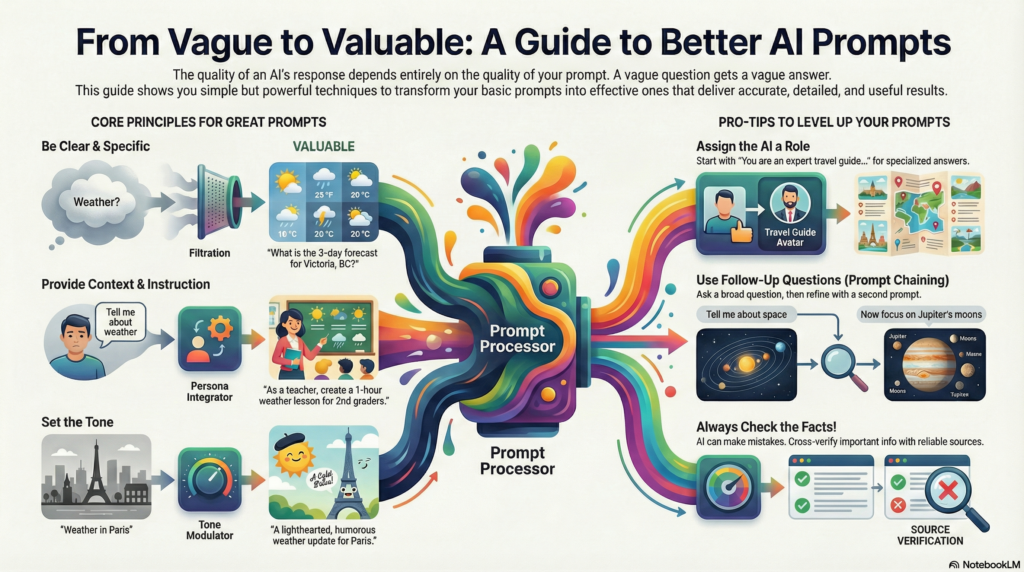
As GenAI is reshaping education at an alarming speed, understanding how it works and critically evaluating its impact on learning is essential. To turn a blind eye to its presence knowing that a vast majority of students engage with it daily, is to fail in our responsibility to equip them with essential skills to navigate a rapidly changing world.
Amy